
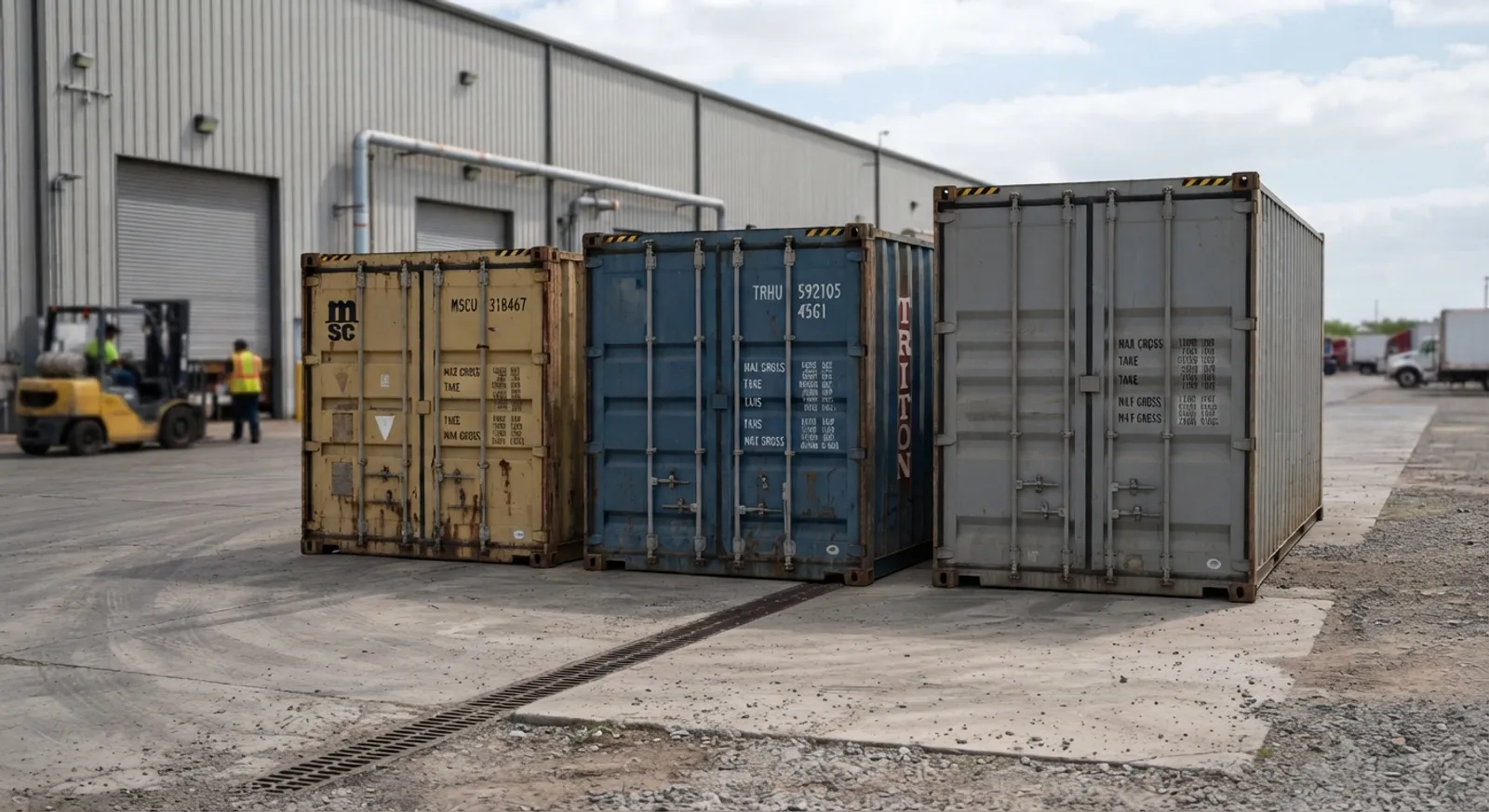
Shipping containers come in more sizes than most people expect. The main ones follow a rule book called ISO 668. Other sizes come from North American rail lines, or from storage-box builders. The three most common are 20ft, 40ft, and the taller 40ft High Cube. Steel Box Direct sells all three, Wind & Water Tight (used). This chart gives the size for each one, from 8ft to 53ft.
The full size chart (8ft to 53ft)
Here is every common size. You’ll see the outside measurements, the inside measurements, the door opening, and how much space each one holds. Outside dimensions for ISO sizes come from ISO 668:2020. Inside dimensions, door openings, and capacities are typical manufacturer figures. They vary slightly by builder.
| Size | Outside (L × W × H) | Inside (L × W × H) | Door opening (W × H) | Holds |
|---|---|---|---|---|
| 8ft1 TRADE |
8'0" × 7'2.6" × 7'5" | ~7'5" × 6'11" × 6'9" | ~6'9" × 6'5" | ~347-352 cu ft |
| 10ft2 TRADE |
9'9.75" × 8'0" × 8'6" | 9'3.5" × 7'8.3" × 7'9.5" | 7'6.9" × 7'5.8" | 557 cu ft |
| 20ft Standard✓ ISO |
19'10.5" × 8'0" × 8'6" | 19'4.2" × 7'8.5" × 7'10.1" | 7'8.1" × 7'5.8" | 1,172 cu ft |
| 20ft High Cube3 ISO |
19'10.5" × 8'0" × 9'6" | 19'4.2" × 7'8.5" × 8'10.1" | 7'8.1" × 8'5.8" | 1,320 cu ft |
| 40ft Standard✓ ISO |
40'0" × 8'0" × 8'6" | 39'5.7" × 7'8.5" × 7'10.1" | 7'8.1" × 7'5.8" | ~2,390 cu ft |
| 40ft High Cube✓ ISO |
40'0" × 8'0" × 9'6" | 39'5.7" × 7'8.5" × 8'10.1" | 7'8.1" × 8'5.8" | ~2,695 cu ft |
| 45ft High Cube4 ISO |
45'0" × 8'0" × 9'6" | 44'5.7" × 7'8.5" × 8'10.1" | 7'8.1" × 8'5.8" | 3,037 cu ft |
| 48ft5 DOMESTIC |
48'0" × 8'6" (102") × 9'6" | Not published, varies | Not published, varies | Not published |
| 53ft6 DOMESTIC |
53'0" × 8'6" (102") × 9'6" | 52'6" × 8'3" × 8'11" to 9'1.5" | 8'2" × 8'11" to 9'1.5" | 3,857 to 3,970 cu ft |
Outside dimensions for ISO sizes per ISO 668:2020. Inside dimensions, door openings, and capacities are typical manufacturer figures and vary slightly by builder.
- 1A storage-market build, never an ocean box. Figures vary by manufacturer.
- 2A trade build. Its 8'6" height is not the ISO 10ft, which is 8'0" tall. Figures vary by builder.
- 3Outside size is ISO. Inside and door figures are typical and depend on the builder.
- 4ISO also defines an 8'6"-tall 45ft container (designation 1EE). You will essentially never see one.
- 5A rare, shrinking legacy fleet. Specialty size; specifications vary and are poorly published.
- 6A domestic rail and truck size, sold regionally near rail hubs. Interior height genuinely differs by build.
The ✓ marks the three sizes Steel Box Direct sells. Each is Wind & Water Tight (used). The other sizes are shown for reference only. See why, below.
Why “inside” is always a little smaller
A “20-foot container” is 20 feet long on the outside. But step inside, and it measures closer to 19 feet 4 inches.
That’s not a mistake. The steel walls, floor, and corner posts all take up a little room. Every size loses a few inches this way. So when you plan what will fit, use the inside numbers. Don’t use the name.
On the ISO sizes, the inside width stays close to 7’8.5”. Length and height are what change from one size to the next. The domestic 48ft and 53ft run a little wider, and the small 8ft runs narrower.
Not sure which size a used container really is? The 4-character size/type code stenciled on its door settles it. Here’s how to read a container’s ID and size/type code, like the 45G1 that marks a 40ft High Cube.
Square feet and cubic feet, explained simply
Two numbers matter most when you picture what fits. They are floor space (square feet) and total room (cubic feet).
- Floor space is length times width. It’s the ground you have to walk on and stack boxes across.
- Cubic feet adds in height. It’s the total room, including anything you stack up high.
Using the inside measurements above, the floor space works out to roughly:
- 10ft: about 70 sq ft
- 20ft (Standard or High Cube): about 150 sq ft
- 40ft (Standard or High Cube): about 305 sq ft
- 45ft High Cube: about 345 sq ft
Why High Cube matters for stacking
A High Cube container has the same footprint as its standard twin. A footprint is just the ground the box covers, like the outline of a rug. But a High Cube stands about a foot taller inside, roughly 8’10” instead of 7’10”. The floor space doesn’t change. The extra headroom does.
That extra foot matters most for pallets stacked two-high, hung shelving, or tall equipment. It’s also why the 40ft High Cube is easier to find used than the plain 40ft standard.
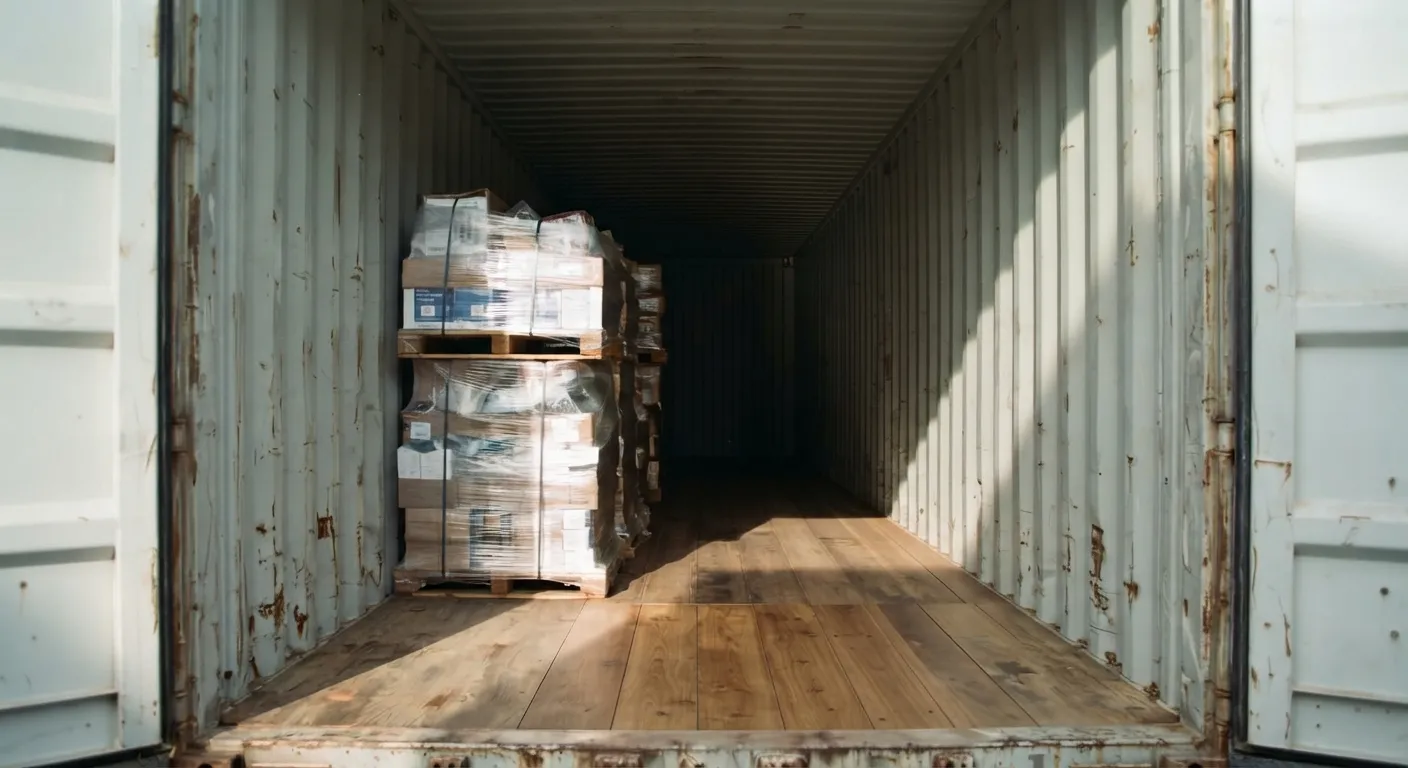
Pallets stacked two-high with room to spare above. The High Cube’s extra foot of interior height is what makes the second layer fit.
What fits in each size
Numbers on a chart are one thing. Here’s a plainer way to picture each size.
- 10ft: about the size of a single-car garage stall, but not as tall. Fits a small vehicle or a modest amount of gear, with little room to spare. Rare used; mostly built new as a storage box.
- 20ft: about the length of two parking spaces, end to end. Fits one tractor and its attachments, a motorcycle collection, seasonal gear, or a compact workshop.
- 40ft: about twice the length of a 20ft, roughly four parking spaces. Fits a full equipment lineup, several vehicles, or a season’s worth of business inventory.
- 40ft High Cube: the same footprint as a 40ft standard, with a foot more headroom. Good for stacked pallets, tall shelving, or equipment with height, like a combine.
- 20ft High Cube and 45ft High Cube: reference sizes, not commonly found used. The 45ft is the largest ISO size. Moving one usually calls for an oversize permit and a special trailer. Checking on permits is the buyer’s job, with the local permitting office.
- 8ft, 48ft, and 53ft: specialty sizes. The 8ft is a small new-build storage box. The 48ft is a rare leftover from an older trucking fleet. The 53ft is a domestic rail box, sold regionally near rail hubs.
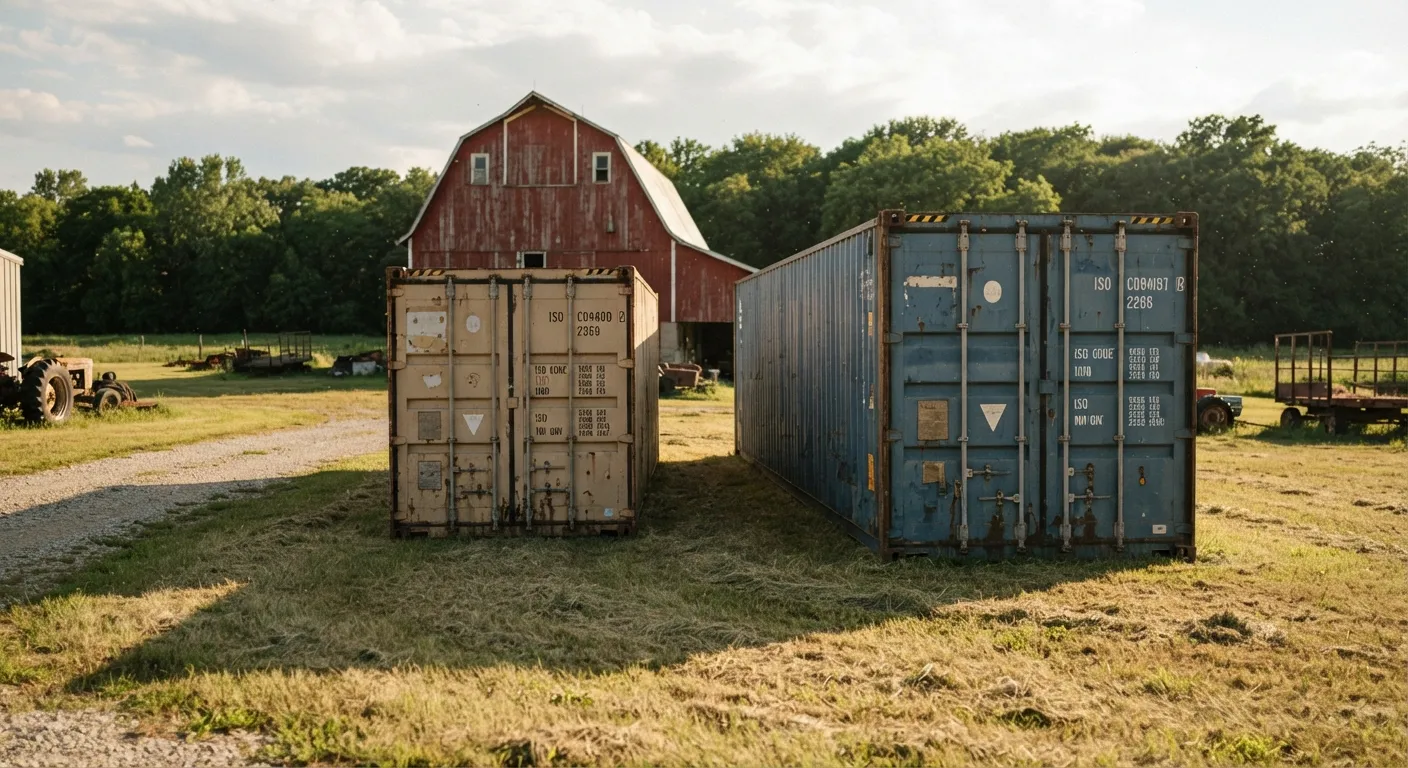
A 20ft and a 40ft side by side on the same farm. Seeing the two lengths together is often the fastest way to judge which one fits your plan.
Want a size picked around your own list of items? Our size guide walks through the decision step by step.
Which sizes does Steel Box Direct actually sell?
Of all the sizes on this chart, Steel Box Direct sells three, all Wind & Water Tight (used):
These three make up almost all of the used market in our region. The other sizes are harder to source. The 8ft and 10ft are mostly built new as storage boxes. The 20ft High Cube and the 48ft are rare. The 45ft High Cube and the 53ft exist, but they move through different channels, like rail yards. We don’t stock any of them. They’re included above so this chart is a complete reference, not because they’re something we offer.
Every container we sell is checked and sealed against rain, wind, snow, and pests before it reaches you. Our condition guide explains exactly what that Wind & Water Tight standard covers, and our plain-English guide to what “Wind & Water Tight” means breaks the grade down term by term.
Use the interactive size calculator
Charts are useful, but a quick back-and-forth is often faster. Answer a few questions about what you’re storing. Our size calculator will point you to the size that fits.
You can also cross-check these figures against the compact dimensions table at Container Reference. It uses the same ISO 668:2020 outside dimensions as this chart.
Ready to see one of these sizes in person? Get a real quote and tell us what you’re storing, and we’ll help you land on the right footprint.